
A Literary Triangle: When Alice B. Toklas Inscribed a Book for Oscar Wilde's Mother-in-Law
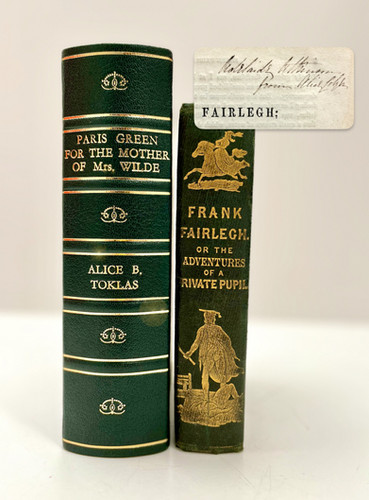
There are moments in the rare book trade when a single inscription can illuminate unexpected connections across literary history. Our recent acquisition—a book inscribed by Alice B. Toklas to Adelaide Atkinson—is precisely such a discovery, bridging the bohemian salons of modernist Paris with the tragic romance of Victorian literary scandal.
The Shakespearen Inscription: A Deliberate Message
What makes this inscription truly extraordinary is not merely that Alice B. Toklas dedicated a book to Adelaide Atkinson—it's the lines she chose from Shakespeare and the devastating commentary they offer on Adelaide's treatment of her daughter.
Toklas inscribed the book with passages from two of Shakespeare's plays. From The Two Gentlemen of Verona, she selected:
"Home-keeping youth have ever homely wits. I rather would entreat thy company To see the wonders of the world abroad, Than living dully, sluggardiz'd at home, Wear out thy youth with shapeless idleness."
And from Romeo and Juliet:
"Where unbruised youth, with unstuff'd brain, Doth couch his limbs, there golden sleep doth reign."
These are not neutral literary ornaments. They speak directly to a tormented and wasted childhood—precisely the kind of childhood Adelaide inflicted upon Constance.
Adelaide Barbara Atkinson holds a particular, if often overlooked, place in literary history as the mother of Constance Lloyd, who married Oscar Wilde in 1884. By all historical accounts, Adelaide was a difficult woman—described by her own son as subjecting Constance to a steady stream of insults and public humiliations, particularly after her husband Horace Lloyd's death in 1874. She kept Constance confined and isolated, denying her the freedom to explore the world beyond their home. This abusive treatment left lasting scars on young Constance, fostering in her a lifelong need for maternal figures and contributing to the fragility that would later define her tragic story.
The choice of Shakespeare's lines about home-keeping youth wasting away in shapeless idleness, and of unbruised youth sleeping peacefully—a state Constance never knew—reads as both reproach and elegy. Was Toklas confronting Adelaide with the consequences of her cruelty? Or was this perhaps a gift given after Adelaide's death, a final statement about the childhood Constance deserved but never received?
Two Literary Worlds Collide
Alice B. Toklas arrived in Paris in 1907, seeking escape from family obligations in San Francisco. There, she met Gertrude Stein, beginning a nearly forty-year partnership that would place them at the epicenter of early 20th-century modernism. Their salon at 27 rue de Fleurus hosted Picasso, Matisse, Hemingway, and countless other luminaries who reshaped art and literature.
By the time Toklas could have inscribed this book, Adelaide's daughter Constance had already lived through one of literature's most heartbreaking scandals. After Oscar Wilde's 1895 conviction and imprisonment, Constance changed her and her sons' surnames to Holland, fleeing to the continent to escape the stigma. She died in 1898 following complications from spinal surgery, never having reconciled with her exiled husband.
The Power of Provenance
What makes this inscription particularly poignant is the intersection it represents between two very different literary epochs. Adelaide Atkinson belonged to a Victorian world of propriety and concealment, where her son-in-law's downfall was treated as a scandal to be fled from. Toklas and Stein, by contrast, lived openly as partners in a relationship that was an open secret among the artistic elite, hosting a salon where convention was constantly challenged.
The fact that Toklas would inscribe a book to Adelaide suggests either a personal connection or perhaps Adelaide's continued involvement in literary circles despite—or perhaps because of—the family tragedy. Did she seek solace in books after losing her daughter? Did she find in Toklas's world a different model of living authentically, one that her daughter might have wished for in her own marriage?
A Treasure
This inscribed volume joins that rare class of books that transcend their content to become historical artifacts. The inscription connects Oscar Wilde's tragic Victorian love story with the triumphant partnership of Gertrude Stein and Alice B. Toklas—reminding us that literary history is not a series of isolated moments but an intricate web of connections, influences, and unexpected friendships.
For collectors of Wilde, Stein, modernist literature, or Victorian literary scandal, this piece offers something truly unique: a tangible link between two of literature's most famous partnerships, one that ended in tragedy and isolation, the other that flourished in the liberating atmosphere of artistic Paris.
It is the human stories behind such inscriptions—the relationships, the gifts, the moments of connection—that transform books from mere objects into windows into lives lived at the intersection of art, scandal, and history.
You can find out more and view images of this dedication at,


Comments